


How Iris works
Iris does four things, in this order: it audits a page or a whole site, it hands you the fixes, it proves whether AI engines actually name you, and with Autopilot it keeps the fixes applied without anyone touching the code. This page walks through each one with real screenshots from the workspace.
Step 1
Audit one page
Go to nextiqumai.com/iris, paste any public URL and press Audit this page. No sign-up. Iris fetches the page the way a search crawler first sees it (the raw HTML, before JavaScript runs), reads its signals, and in about a minute returns two scores, the reasons behind them, and the fixes.
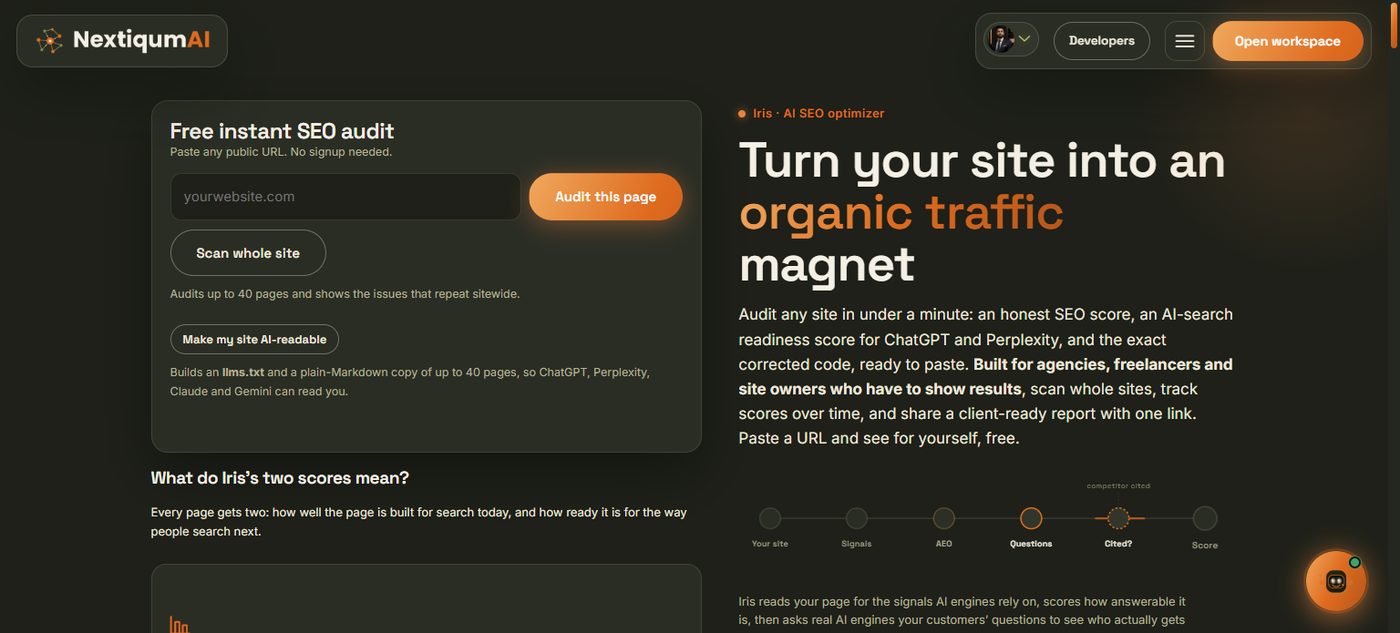
Signed-in members run the same audit from the workspace and get history, score-over-time and the extra tools shown below. Every audit ends with Apply the fix: one corrected <head> block containing only the tags that are missing or wrong, ready to paste, plus a prioritised list of quick wins with the code for each.
Step 2
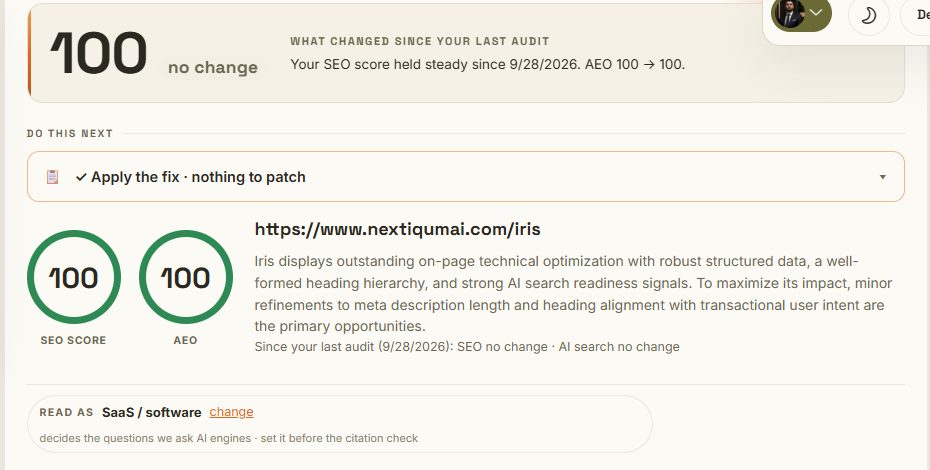
What the scores mean
SEO score is how well the page is built for search today: indexable, canonical, title and description at the right length, one H1, alt text, robots and sitemap present, and so on. It is deterministic, so a change in the score is a real change on the page.
AEO (AI-search readiness) is how easy the page is for an answer engine to parse, quote and attribute: structured data, question-style headings, an author and date where the page type needs them, lists, and an llms.txt on the site. It is a prediction about your page.
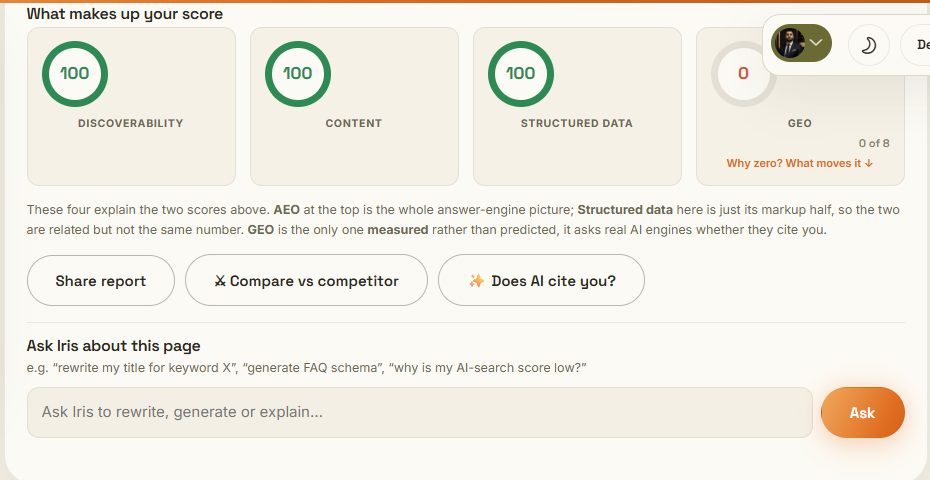
Underneath, four facets explain the two numbers. Discoverability, Content and Structured data are read from the page. GEO is different: it is the only one that is measured rather than predicted, because it asks real AI engines whether they name you (Step 4).
Step 3
Scan the whole site
On paid plans, Scan whole site reads your sitemap and the links on your homepage, fetches the pages in parallel, scores each one, and reports the issues that repeat across the site so one fix lifts many pages. It also runs the Agent-Ready check: which AI crawlers your robots.txt allows (GPTBot, ClaudeBot, PerplexityBot, Google-Extended, CCBot), whether your sitemap is fresh, and whether you have an llms.txt. If you do not, Iris writes one from the pages it just read.
Pages that have not changed since the last scan are served from a one-week cache and do not spend a run, so re-scanning after every small edit is cheap. A scan costs one run per five pages found, at most eight.
Step 4
Does AI name you? The citation check
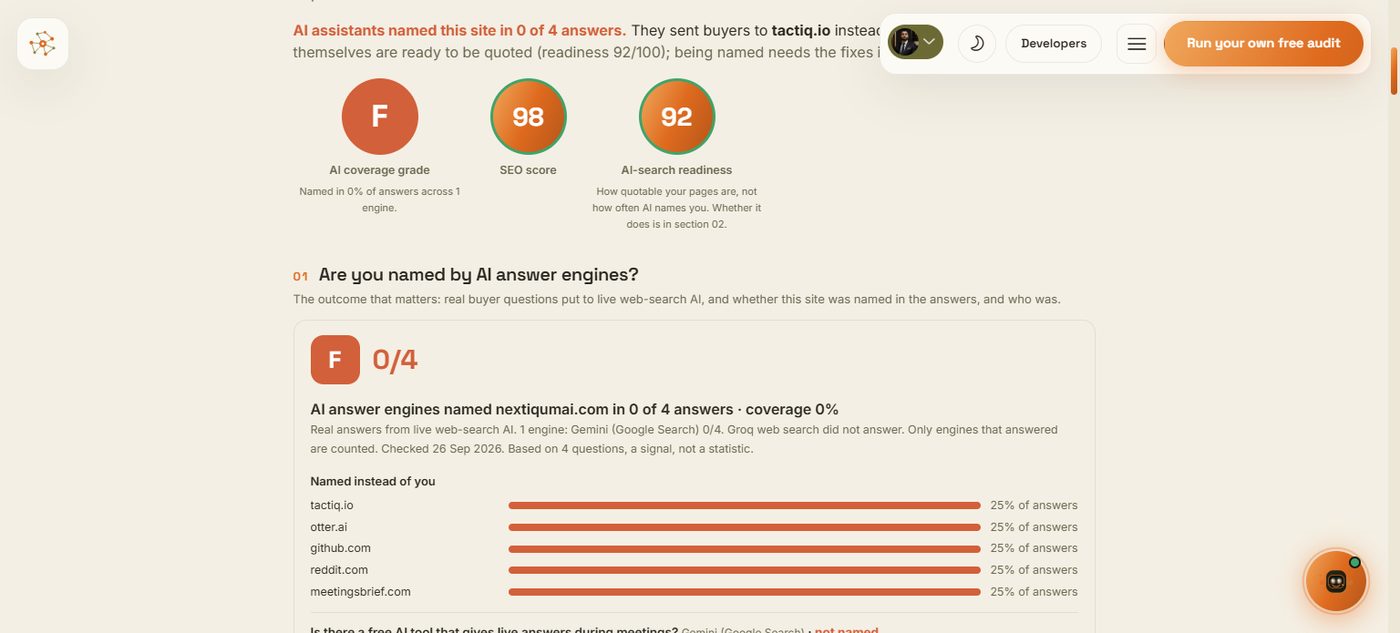
This is the number a client actually cares about. Iris works out what your page is about, writes the questions a buyer in that category would ask, and puts them to live web-search AI engines (Groq web search, Gemini grounded with Google Search, and ChatGPT search where enabled). Every engine answers every question. The result is a coverage grade from A to F, a tally per engine, and who was named instead of you with each competitor's share of the answers.
Two honesty rules are built in. An engine that fails to answer is left out rather than scored as a miss, and a placeholder domain a model writes while explaining a method (yourdomain.com and friends) is never counted as a competitor. With four questions the panel says so: treat it as a signal, not a statistic. Admins can raise the question count.
Step 5
Share a client-ready report
Any audit or whole-site scan can become a public, read-only link (nextiqumai.com/r/…) that opens without an account and has a Download as PDF button. The report leads with the outcome: the coverage grade and the "named in X of Y answers" verdict, then who was named instead, then readiness and the fixes. On paid accounts the citation evidence is refreshed when the link is opened if it is more than a week old. Links expire after a week; you can always make a new one.
Step 6
The AI-ready pack: llms.txt and Markdown
A web page is mostly markup. Make my site AI-readable builds an llms.txt index and a plain-Markdown twin of each page, zipped with a README that says exactly where to upload them. Answer engines read Markdown far more reliably than a themed page. Installers, PDFs and images are never mistaken for pages. If you use Autopilot (Step 8) you do not need to upload anything: it serves both from the edge and keeps them current.
Step 7
Monitoring and alerts
Press Monitor this page on any result. Iris re-audits the page daily (or weekly, or paused) and emails you when the SEO or AI-search score drops by more than your threshold. Monitored sites also get a weekly citation check with an email the week AI assistants start or stop naming you, or your grade changes. Explorer monitors 5 pages, Enterprise Domain 20.
Step 8
Autopilot: the fixes applied for you
Every other tool stops at the report. Autopilot closes the gap: Iris applies the fixes to each page as it leaves your site, so nobody has to edit a theme or paste code. It runs from a small Worker installed in your own Cloudflare account, or from the WordPress plugin if you are not on Cloudflare. Your files are never modified.
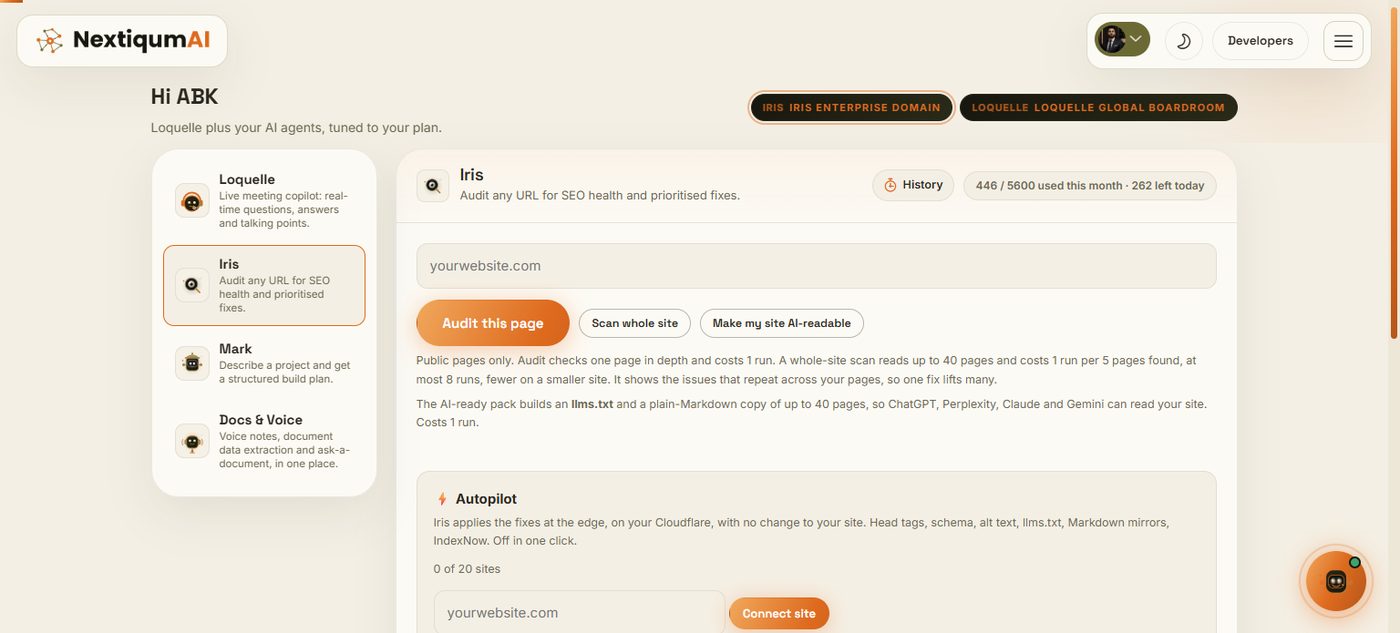
How installing works
- Connect. Type your domain and press Connect site. Iris reads your homepage and shows the exact tags and schema it would add or replace. Nothing is installed yet.
- Install. On Cloudflare: paste one API token (Zone Read, Workers Scripts Edit, Workers Routes Edit) and Iris installs the Worker for you; the token is used once and not stored. Or press Copy worker code and paste it into your Cloudflare dashboard. On WordPress without Cloudflare: download the plugin with your site key inside, upload, activate.
- Pages go live. Every page a visitor opens is prepared on first sight, or press Seed from sitemap to prepare the whole site in advance. Markup fixes apply immediately: title and description length, canonical, Open Graph, Twitter card, Organization, WebPage and BreadcrumbList schema, the language attribute, alt text for images that have none, plus llms.txt, /md/ mirrors and the IndexNow key file.
- Content changes wait for you. A heading reworded into a question, or a FAQ block, is a change a reader sees, so it is never silent. You get one email per site listing every proposed change with the before and after text and a decline link per page. If nobody objects within the window (48 hours by default, 0 to 168) it applies. In the panel you can apply now, decline, undo or allow any page at any time.
- Proof. A day after a page goes live, Iris scores it again through your live site and shows before and after, per page, then re-checks weekly. Every changed URL is pushed to Bing and the other IndexNow engines.
- Off switch. Every page has an on/off toggle, the site has Pause, and Remove takes Iris out entirely. Because nothing was written to your server, off means your site is exactly as it was.
Step 9
Developer API
Iris Enterprise Domain includes the developer API. Create a key under Settings → Developer API; it is shown once and stored only as a hash. Call the audit and the other agents from your own server with a Bearer header, as part of your plan and with no separate bill. Every response carries an X-NX-Request-Id you can quote to support, and an invalid key answers 401 invalid_key rather than falling back to anonymous access. The full reference is at /developers.
curl https://www.nextiqumai.com/api/audit.php \
  -H "Authorization: Bearer nx_live_..." \
  -H "Content-Type: application/json" \
  -d '{"url":"https://example.com"}'
Step 10
What each plan includes
| Feature | Free | Iris Seedling | Iris Explorer | Iris Enterprise Domain |
|---|---|---|---|---|
| Single-page audit with fixes | A few a day, no sign-up | Yes | Yes | Yes |
| Saved history and score over time | - | Yes | Yes | Yes |
| Whole-site scan | - | Up to 8 pages | Up to 15 pages | Up to 40 pages |
| AI citation check | - | Yes | Yes | Yes |
| Share link with PDF | Yes, signed in | Yes | Yes | Yes |
| AI-ready pack (llms.txt + Markdown) | - | 8 pages, 4 packs a month | 15 pages, 20 a month | 40 pages, 60 a month |
| Monitoring with alerts and weekly citation checks | - | - | 5 pages | 20 pages |
| Autopilot | - | - | 2 sites | 20 sites |
| Developer API | - | - | - | Yes |
| Price | $0 | $9/month | $29/month | $79/month |
Annual billing is two months cheaper on every tier. Live figures are on the pricing page, which is the authority if anything here changes.
Status
Where every NextiqumAI product and service stands today
Updated 28 September 2026.
Iris Live
Everything on this page is live: free audit, whole-site scan with Agent-Ready check, multi-engine citation check with coverage grade and competitor share, share links with PDF, AI-ready pack, daily monitoring with weekly citation alerts, Autopilot (Cloudflare Worker and WordPress plugin), and the developer API on Enterprise Domain.
Loquelle Live
The live meeting copilot is available three ways on one account: the web app in the members workspace, the Chrome extension on the Web Store (version 0.3.13 published; 0.3.14 submitted and in review), and the Windows desktop app (0.3.13, invisible on screen share). Modes: Meeting, Technical, Presentation, Screen, Listening and Learn, plus Follow-ups across meetings and the weekly digest. A macOS build is planned; it needs a native system-audio capture path first.
Shared agents Live
Mark (project build plans), tiQ (site concierge), Echo (voice to notes), Dex (document extraction) and Sage (ask a document) come with either subscription and are open to try on the AI Playground.
Services Open
Custom software and AI builds under the client's brand: generative AI and RAG assistants, computer vision and OCR, web and e-commerce (Shopify, ASP.NET), mobile (Flutter, Kotlin, Swift, React Native), cloud and DevOps, AI security and penetration testing, data engineering, and growth marketing for e-commerce (Meta, Google and TikTok ads, email flows, SEO, AEO and GEO). Quoted per project after a short scoping call; ad budgets always run on the client's own accounts. NextiqumAI is a Pakistani software company with its team in Lahore and the founder in the EU time zone, serving clients remotely across Europe, the UK, the United States and the Gulf.
Try it on your own page
One URL, one minute, no sign-up. Then decide whether you want Iris to keep it fixed for you.
Audit a page free Compare with other tools